- New
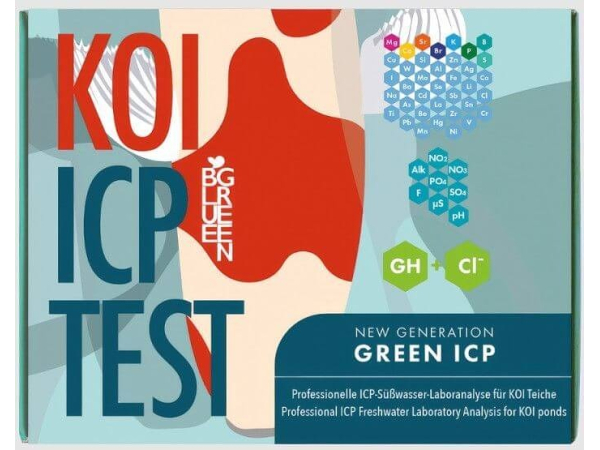
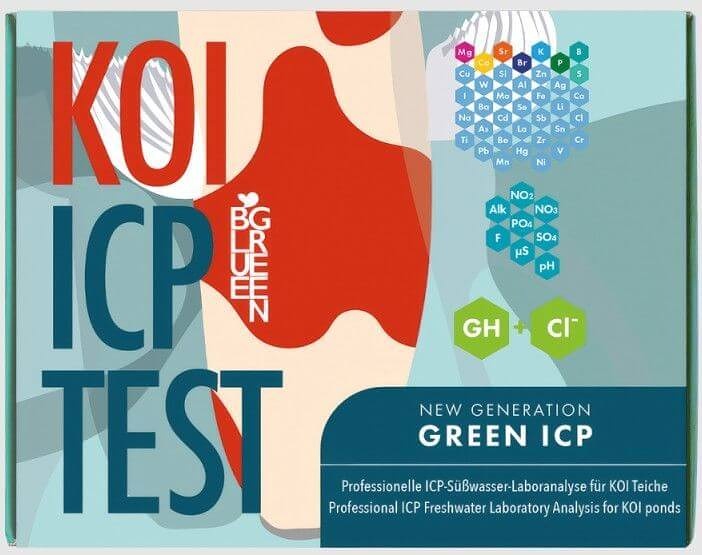



The KOI Blue Green ICP Test Fauna Marin is a professional water analysis specially designed for koi ponds. Performed in the laboratory using ICP-OES, photometry, and electrochemical methods, it checks more than 50 values and ratios, including macroelements, nutrients, trace elements, and pollutants.





| Date Maximum delivery |
|
|---|---|
| Express | Monday 21 September |
| Pick-up point |
Monday 21 September
Wednesday 23 September |
| Home |
Tuesday 22 September
Wednesday 23 September |
| See all delivery fees | Cart amount | Delivery fees |
|---|---|---|
| Colis sur pré-commande | 0 à 158,98 € | 7,80 € |
| 158,99 à 248,98 € | Free | |
| 248,99 à 10 000 € | Free | |
| DPD Livraison en relais Pickup | 0 à 68,98 € | 6,90 € |
| 68,99 à 10 000 € | Free | |
| DPD Livraison sur lieu de travail | 0 à 10 000 € | 7,80 € |
| DPD Livraison à domicile Predict sur créneau horaire | 0 à 68,98 € | 7,80 € |
| 68,99 à 158,98 € | 7,80 € | |
| 158,99 à 10 000 € | Free | |
| En Relais GLS | 0 à 68,98 € | 6,90 € |
| 68,99 à 10 000 € | Free | |
| EXPRESS 24H Vivant - Live - Lebenden - Vivo - Levend | 0 à 248,99 € | 24,90 € |
| 248,99 à 100 000 € | Free | |
| GLS À domicile | 0 à 68,98 € | 7,80 € |
| 68,99 à 158,98 € | 7,80 € | |
| 158,99 à 10 000 € | Free | |
| Livraison palette – Pallet Delivery | 0 à 50 kg | 50 € |
| UPS Matériel Domicile EXPRESS 24H | 0 à 15 000 € | 19,90 € |
| Country | Carrier | Cart amount | Delivery fees |
|---|---|---|---|
| Europe zone 1 | Colis sur pré-commande | 0 à 158,98 € | 15,90 € |
| 158,99 à 248,98 € | 15,90 € | ||
| 248,99 à 10 000 € | Free | ||
| DPD Livraison en relais Pickup | 0 à 68,98 € | 6,90 € | |
| 68,99 à 10 000 € | Free | ||
| DPD Livraison internationale | 0 à 248,98 € | 15,90 € | |
| 248,99 à 10 000 € | Free | ||
| DPD Livraison sur lieu de travail | 0 à 10 000 € | 7,80 € | |
| EXPRESS 24H Vivant - Live - Lebenden - Vivo - Levend | 0 à 248,99 € | 29,89 € | |
| 248,99 à 100 000 € | Free | ||
| Livraison palette – Pallet Delivery | 0 à 50 kg | 259 € | |
| France | Colis sur pré-commande | 0 à 158,98 € | 7,80 € |
| 158,99 à 248,98 € | Free | ||
| 248,99 à 10 000 € | Free | ||
| DPD Livraison en relais Pickup | 0 à 68,98 € | 6,90 € | |
| 68,99 à 10 000 € | Free | ||
| DPD Livraison sur lieu de travail | 0 à 10 000 € | 7,80 € | |
| DPD Livraison à domicile Predict sur créneau horaire | 0 à 68,98 € | 7,80 € | |
| 68,99 à 158,98 € | 7,80 € | ||
| 158,99 à 10 000 € | Free | ||
| En Relais GLS | 0 à 68,98 € | 6,90 € | |
| 68,99 à 10 000 € | Free | ||
| EXPRESS 24H Vivant - Live - Lebenden - Vivo - Levend | 0 à 248,99 € | 24,90 € | |
| 248,99 à 100 000 € | Free | ||
| GLS À domicile | 0 à 68,98 € | 7,80 € | |
| 68,99 à 158,98 € | 7,80 € | ||
| 158,99 à 10 000 € | Free | ||
| Livraison palette – Pallet Delivery | 0 à 50 kg | 50 € | |
| UPS Matériel Domicile EXPRESS 24H | 0 à 15 000 € | 19,90 € | |
| Europe zone 2 | Colis sur pré-commande | 0 à 158,98 € | 39,90 € |
| 158,99 à 248,98 € | 39,90 € | ||
| 248,99 à 10 000 € | 39,90 € | ||
| DPD Livraison en relais Pickup | 0 à 68,98 € | 12,90 € | |
| 68,99 à 10 000 € | 12,90 € | ||
| DPD Livraison internationale | 0 à 248,98 € | 39,90 € | |
| 248,99 à 10 000 € | 39,90 € | ||
| EXPRESS 24H Vivant - Live - Lebenden - Vivo - Levend | 0 à 248,99 € | 39,90 € | |
| 248,99 à 100 000 € | 39,90 € | ||
| Livraison palette – Pallet Delivery | 0 à 50 kg | 359 € | |
| Suisse | Colis sur pré-commande | 0 à 158,98 € | 39,90 € |
| 158,99 à 248,98 € | 39,90 € | ||
| 248,99 à 10 000 € | 39,90 € | ||
| DPD Livraison en relais Pickup | 0 à 68,98 € | 26,90 € | |
| 68,99 à 10 000 € | 26,90 € | ||
| DPD Livraison internationale | 0 à 248,98 € | 39,90 € | |
| 248,99 à 10 000 € | 39,90 € | ||
| Livraison palette – Pallet Delivery | 0 à 50 kg | 389 € | |
| Suisse - EXPRESS 24H Vivant - Live - Lebenden - Vivo – Levend | 0 à 100 000 € | 44,90 € |
You might also like












The KOI Blue Green ICP Test Fauna Marin provides a complete professional analysis of koi pond water with more than 50 measured and calculated values in the laboratory.
The KOI Blue Green ICP Test from Fauna Marin is a laboratory analysis specially developed to precisely monitor the water composition of ponds housing koi carp. Based on the proven Blue Green Fresh ICP technology, this test has been adapted to the specific requirements of koi ponds.
Unlike quick tests performed directly at the pond side, the Blue Green ICP Koi Test combines different professional laboratory technologies to provide a much more complete picture of the water composition.
The analysis makes it possible to measure and interpret more than 50 values and ratios, including macroelements, trace elements, nutrients, and various pollutants potentially present in the pond.
Fauna Marin uses several complementary analytical methods. The ICP-OES technology makes it possible to precisely identify many macroelements and trace elements present in the water.
This analysis is supplemented by photometric and electrochemical methods to measure certain parameters that are not directly determined by ICP-OES, such as nitrates, nitrites, or different forms of phosphates.
One of the main advantages of the KOI Blue Green ICP Test Fauna Marin lies in the use of reference values specially adapted to koi ponds. The interpretation of the results therefore takes into account the particularities of these systems, often characterized by a large fish population, heavy feeding, and a high organic load.
| Method | Use |
|---|---|
| ICP-OES | Analysis of macroelements, trace elements, and various metallic contaminants. |
| Photometry | Analysis of various nutrients such as nitrates, nitrites, and phosphates. |
| Electrochemical methods | Measurement of additional parameters such as pH or conductivity. |
The Blue Green ICP Koi Test provides a particularly detailed analysis of pond water composition. It makes it possible to monitor the main mineral elements, nutrients, trace elements, as well as a large number of undesirable substances.
| Electrical conductivity | Overall measure of the concentration of dissolved elements in the water. |
| Total hardness | Assessment of the overall mineralization of the water. |
| pH | Measure of the acidity or alkalinity of the water. |
| Alkalinity / KH | Assessment of the buffering capacity of the water. |
| CO2 | Assessment of the carbon dioxide concentration. |
| Acid-binding capacity | Additional value used to characterize the chemical balance of the water. |
The analysis includes in particular sodium, magnesium, sulfur in sulfate form, calcium, potassium, strontium, and boron.
The test also measures various halogens such as chloride, fluoride, bromide, and iodine.
The laboratory analyzes in particular nitrates, nitrites, phosphorus, total phosphate, orthophosphate, silicon, and silicate.
The KOI Blue Green ICP Test searches for a large number of elements present at very low concentrations, making it possible in particular to identify certain potentially problematic contaminants.
| Category | Elements analyzed |
|---|---|
| Trace elements and metals | Aluminum, barium, cobalt, iron, copper, lithium, manganese, molybdenum, nickel, vanadium, zinc, and other elements. |
| Potential pollutants | Antimony, arsenic, beryllium, lead, cadmium, chromium, mercury, silver, tin, and other metallic contaminants. |
| Additional elements | Lanthanum, selenium, titanium, tungsten, zirconium, and various trace elements. |
A koi pond works differently from a classic aquarium. The number of fish, their size, their feeding, and the significant production of organic waste place heavy demands on filtration and can gradually alter the chemical composition of the water.
Traditional tests make it possible to regularly monitor certain essential parameters, but they do not always make it possible to detect an accumulation of metals, an unusual concentration of a trace element, or an imbalance between several elements.
The KOI Blue Green ICP Test Fauna Marin therefore makes it possible to carry out an in-depth check of the pond in order to more easily identify any anomaly invisible with conventional tests.
The interpretation of the results is based on references specifically adapted to koi ponds. This provides a more relevant reading of the results than a comparison with generic values intended for freshwater or a traditional aquarium.
The report also makes it possible to study various ratios between macroelements and nutrients, in order to obtain an overall view of the chemical balance of the water.
The Blue Green ICP Koi Test is a particularly useful tool when a difficult-to-identify problem appears, for periodic pond monitoring, or simply to verify the actual composition of the water being used.
Thanks to an analysis combining ICP-OES, photometry, and electrochemical methods, the KOI Blue Green ICP Test goes much further than routine analyses and provides a true snapshot of the pond's chemical composition.
Key point: the KOI Blue Green ICP Test Fauna Marin analyzes more than 50 measured and calculated values and uses references specially adapted to the requirements of koi ponds.
The KOI Blue Green ICP Test Fauna Marin is a professional water analysis specially designed for koi ponds. Performed in the laboratory using ICP-OES, photometry, and electrochemical methods, it checks more than 50 values and ratios, including macroelements, nutrients, trace elements, and pollutants.