- Out-of-Stock
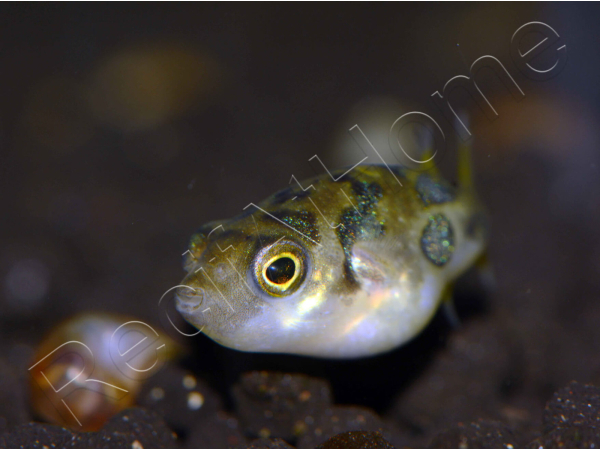



The Carinotetraodon travancoricus is a freshwater fish from India. Its tiny size makes it one of the smallest pufferfish in existence. Whether solitary or in groups, it prefers slow-moving or stagnant waters.




| See all delivery fees | Cart amount | Delivery fees |
|---|---|---|
| EXPRESS 24H Vivant - Live - Lebenden - Vivo - Levend | 0 à 248,99 € | 24,90 € |
| 248,99 à 100 000 € | Free |
| Country | Carrier | Cart amount | Delivery fees |
|---|---|---|---|
| Europe zone 1 | EXPRESS 24H Vivant - Live - Lebenden - Vivo - Levend | 0 à 248,99 € | 29,89 € |
| 248,99 à 100 000 € | Free | ||
| Europe zone 2 | EXPRESS 24H Vivant - Live - Lebenden - Vivo - Levend | 0 à 248,99 € | 39,90 € |
| 248,99 à 100 000 € | 39,90 € | ||
| France | EXPRESS 24H Vivant - Live - Lebenden - Vivo - Levend | 0 à 248,99 € | 24,90 € |
| 248,99 à 100 000 € | Free |
Living in the freshwater of India, the Carinotetraodon travancoricus, also known as the Malabar dwarf pufferfish, is a tropical species and one of the smallest among pufferfish. Indeed, this fish rarely exceeds 2 cm in length. Its recognizable yellow color with black spots and white belly make it easily identifiable. It is not very territorial and has a diurnal lifestyle, sometimes solitary but can move in groups on other occasions. Generally, it swims at mid-height or near the bottom. As a micro-predator, it primarily feeds on mollusks. Therefore, raising it in cohabitation with mollusks and crustaceans is unfeasible.
For its maintenance, a minimum 50 L aquarium is required. The water temperature should range between 22° and 28°C, with a pH between 7.2 and 8. When integrating it into a community tank, it is very important to avoid the company of other pufferfish for the Carinotetraodon travancoricus. Despite its relatively calm behavior, associating it with other species can be complex and risky. Additionally, this specimen contains a large amount of tetrodotoxin in its body, which is fatal in 50% of cases for other individuals. Consuming this fish can, therefore, cause health problems in humans, ranging from simple poisoning to muscle paralysis, and even death in the most critical cases. It is thus mandatory to seriously research beforehand.
The Carinotetraodon travancoricus is a freshwater fish from India. Its tiny size makes it one of the smallest pufferfish in existence. Whether solitary or in groups, it prefers slow-moving or stagnant waters.