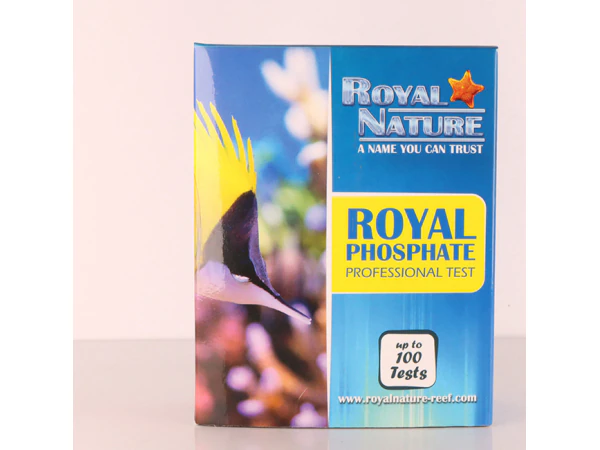






Phosphate Test Professional Royal Nature 100 tests, designed to accurately measure the concentration of phosphates in marine and reef aquarium water, with results expressed in PPM.





| Date Maximum delivery |
|
|---|---|
| Express | Tuesday 06 October |
| Pick-up point |
Tuesday 06 October
Thursday 08 October |
| Home |
Wednesday 07 October
Thursday 08 October |
| See all delivery fees | Cart amount | Delivery fees |
|---|---|---|
| Colis sur pré-commande | 0 à 158,98 € | 7,80 € |
| 158,99 à 248,98 € | Free | |
| 248,99 à 10 000 € | Free | |
| DPD Livraison en relais Pickup | 0 à 68,98 € | 6,90 € |
| 68,99 à 10 000 € | Free | |
| DPD Livraison sur lieu de travail | 0 à 10 000 € | 7,80 € |
| DPD Livraison à domicile Predict sur créneau horaire | 0 à 68,98 € | 7,80 € |
| 68,99 à 158,98 € | 7,80 € | |
| 158,99 à 10 000 € | Free | |
| En Relais GLS | 0 à 68,98 € | 6,90 € |
| 68,99 à 10 000 € | Free | |
| EXPRESS 24H Vivant - Live - Lebenden - Vivo - Levend | 0 à 248,99 € | 24,90 € |
| 248,99 à 100 000 € | Free | |
| GLS À domicile | 0 à 68,98 € | 7,80 € |
| 68,99 à 158,98 € | 7,80 € | |
| 158,99 à 10 000 € | Free | |
| Livraison palette – Pallet Delivery | 0 à 50 kg | 50 € |
| UPS Matériel Domicile EXPRESS 24H | 0 à 15 000 € | 19,90 € |
| Country | Carrier | Cart amount | Delivery fees |
|---|---|---|---|
| Europe zone 1 | Colis sur pré-commande | 0 à 158,98 € | 15,90 € |
| 158,99 à 248,98 € | 15,90 € | ||
| 248,99 à 10 000 € | Free | ||
| DPD Livraison en relais Pickup | 0 à 68,98 € | 6,90 € | |
| 68,99 à 10 000 € | Free | ||
| DPD Livraison internationale | 0 à 248,98 € | 15,90 € | |
| 248,99 à 10 000 € | Free | ||
| DPD Livraison sur lieu de travail | 0 à 10 000 € | 7,80 € | |
| EXPRESS 24H Vivant - Live - Lebenden - Vivo - Levend | 0 à 248,99 € | 29,89 € | |
| 248,99 à 100 000 € | Free | ||
| Livraison palette – Pallet Delivery | 0 à 50 kg | 259 € | |
| France | Colis sur pré-commande | 0 à 158,98 € | 7,80 € |
| 158,99 à 248,98 € | Free | ||
| 248,99 à 10 000 € | Free | ||
| DPD Livraison en relais Pickup | 0 à 68,98 € | 6,90 € | |
| 68,99 à 10 000 € | Free | ||
| DPD Livraison sur lieu de travail | 0 à 10 000 € | 7,80 € | |
| DPD Livraison à domicile Predict sur créneau horaire | 0 à 68,98 € | 7,80 € | |
| 68,99 à 158,98 € | 7,80 € | ||
| 158,99 à 10 000 € | Free | ||
| En Relais GLS | 0 à 68,98 € | 6,90 € | |
| 68,99 à 10 000 € | Free | ||
| EXPRESS 24H Vivant - Live - Lebenden - Vivo - Levend | 0 à 248,99 € | 24,90 € | |
| 248,99 à 100 000 € | Free | ||
| GLS À domicile | 0 à 68,98 € | 7,80 € | |
| 68,99 à 158,98 € | 7,80 € | ||
| 158,99 à 10 000 € | Free | ||
| Livraison palette – Pallet Delivery | 0 à 50 kg | 50 € | |
| UPS Matériel Domicile EXPRESS 24H | 0 à 15 000 € | 19,90 € | |
| Europe zone 2 | Colis sur pré-commande | 0 à 158,98 € | 39,90 € |
| 158,99 à 248,98 € | 39,90 € | ||
| 248,99 à 10 000 € | 39,90 € | ||
| DPD Livraison en relais Pickup | 0 à 68,98 € | 12,90 € | |
| 68,99 à 10 000 € | 12,90 € | ||
| DPD Livraison internationale | 0 à 248,98 € | 39,90 € | |
| 248,99 à 10 000 € | 39,90 € | ||
| EXPRESS 24H Vivant - Live - Lebenden - Vivo - Levend | 0 à 248,99 € | 39,90 € | |
| 248,99 à 100 000 € | 39,90 € | ||
| Livraison palette – Pallet Delivery | 0 à 50 kg | 359 € | |
| Suisse | Colis sur pré-commande | 0 à 158,98 € | 39,90 € |
| 158,99 à 248,98 € | 39,90 € | ||
| 248,99 à 10 000 € | 39,90 € | ||
| DPD Livraison en relais Pickup | 0 à 68,98 € | 26,90 € | |
| 68,99 à 10 000 € | 26,90 € | ||
| DPD Livraison internationale | 0 à 248,98 € | 39,90 € | |
| 248,99 à 10 000 € | 39,90 € | ||
| Livraison palette – Pallet Delivery | 0 à 50 kg | 389 € | |
| Suisse - EXPRESS 24H Vivant - Live - Lebenden - Vivo – Levend | 0 à 100 000 € | 44,90 € |
You might also like


The Royal Nature Phosphate Professional Test 100T is a colorimetric test designed for the accurate measurement of phosphates in marine and reef aquarium water. Results are expressed in PPM and each kit allows for up to 100 tests.
Test type: phosphates.
Number of tests: 100.
Measurement unit: PPM.
Use: marine and reef aquarium.
Using the 5 ml syringe, add 5 ml of aquarium water to the test vial.
Add one level spoon of PO4-1 reagent to the test vial and gently shake for 10 seconds.
Then add 5 drops of PO4-2 reagent to the vial and gently shake for 10 to 20 seconds.
Let the solution sit for 1 minute.
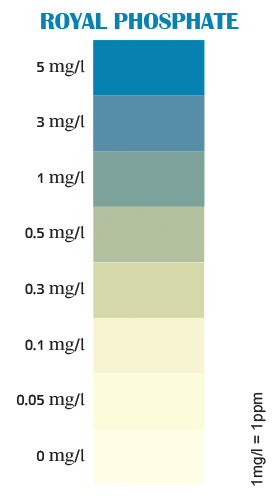
Hold the test vial next to the provided color chart on a white area, then compare the color obtained with the scale. An intermediate color corresponds to an intermediate phosphate concentration.
Keep the kit out of reach of children.
Before use, ensure that the test vial and the measuring scoop are washed only with osmosis water and dried with a soft paper.
Phosphorus is a fundamental element of living matter and is present in reef aquarium water as PO4. The main sources of phosphates come from fish feeding. A single feeding of 5 g of food can significantly increase PO4 levels in an aquarium.
Tap water can also be an important source of phosphates, which justifies the use of osmosis water for preparation and water changes.
The phosphate concentration in natural seawater is about 0.06 PPM. In reef areas, it is generally between 0.01 and 0.02 PPM.
The Royal Phosphate kit allows the determination of PO4 content using a finely adjusted color scale, covering a range of concentrations of 0.05, 0.1, 0.3, 0.5, 1, 3, and 5 PPM.
Royal Nature designed this test to improve readability and precision of results. The color chart is based on analytical studies corresponding to the average reflection of the human eye, in order to reduce the influence of external factors such as ambient lighting.
The Royal Nature phosphate test is based on a two-step process using an indicator and a powder reagent. This design allows for precise monitoring of low PO4 concentrations, close to natural values, while offering an extended and precise reading range.
For reliable reading, compare the colors under neutral and even lighting.
Phosphate Test Professional Royal Nature 100 tests, designed to accurately measure the concentration of phosphates in marine and reef aquarium water, with results expressed in PPM.